2026
Sustainability
Impact
uicINTERNATIONAL UNION OF RAILWAYS
Winner · Energy & Decarbonisation

Connolly Station, 1844
Deep Energy Retrofit

UIC Sustainability Impact Awards 2026 — Irish Rail / Iarnród Éireann

"Proving that the greenest building is the one already built."

88%
Energy demand cut
2.5kg
CO₂e/m² embodied
12yr
Cost recovery
1 of 6
NIAH National rated

Jury Citation — Press Release N° 8/2026

“The Irish Rail project to restore a grand, historic train station was grand in its own way, making this station an icon of sustainability as well as of architecture.”

Lewis Fulton, Jury Member

Awards ceremony held 23 September 2026, InnoTrans Berlin, at Alstom's booth, in partnership with the Sustainable Development Foundation · Paris, 25 September 2026

First held in 2024, the UIC Sustainability Impact Awards' Energy & Decarbonisation category was previously won by DB Cargo Group for Fuel for the Future — HVO@DB Cargo, a fleet-wide switch to hydrotreated vegetable oil biofuel. From a locomotive fuel programme to an 1844 building fabric — the category rewards very different routes to the same result. 2024 winners ↗

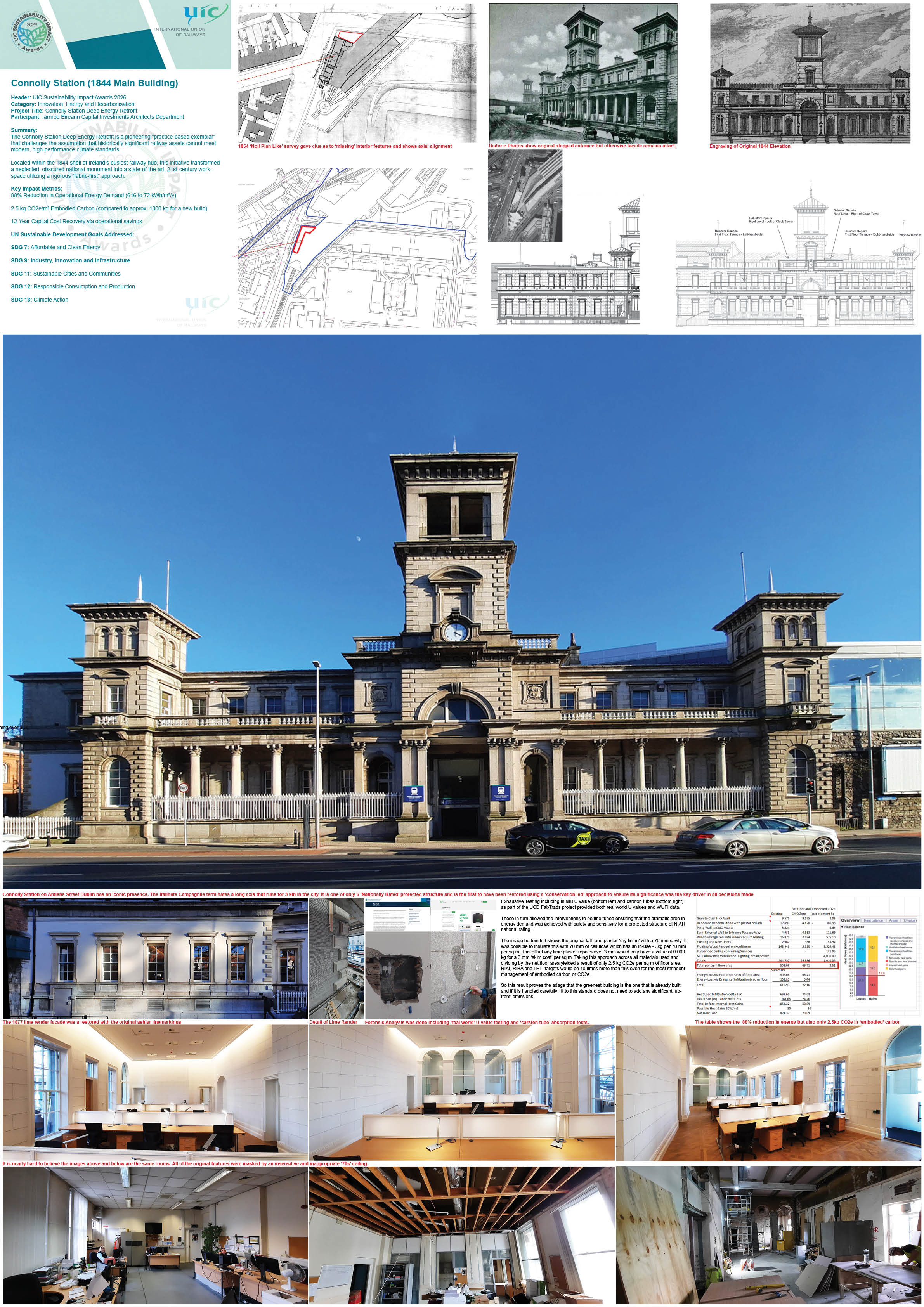
Official UIC Sustainability Impact Awards 2026 entry panel for Connolly Station (1844 Main Building) — summary, key impact metrics and SDGs addressed

The official UIC Sustainability Impact Awards entry panel for Connolly Station (1844 Main Building) — click to enlarge

The Building & The Challenge

A National Monument Transformed

Connolly Station's 1844 Italianate main building is one of Ireland's most significant railway landmarks — its campanile terminates a 3 km urban axis through Dublin city. Before this project, it was a neglected, energy-intensive workspace, its original features obscured by insensitive 1970s interventions.

Classified at NIAH 'National' level — the highest tier of Ireland's 55,000-structure heritage database, broadly equivalent to a Grade 1 Listed Building. Only around 1,000 structures in Ireland carry this rating; Irish Rail's entire estate has just six.

The challenge was to achieve a deep energy retrofit using a fabric-first, conservation-led approach — without compromising the building's protected status. This is the first NIAH National-rated structure in Ireland to be restored using that methodology.

Located within the original 1844 shell of Ireland's busiest railway hub, the initiative transformed an obscured national monument into a state-of-the-art 21st-century workspace.

1844
Year of original construction
NIAH National
Highest heritage rating tier — ~1 in 1,000 structures in Ireland · Buildings of Ireland listing ↗
1 of 6
National-rated structures in the entire Irish Rail estate
First
NIAH National structure restored using a conservation-led approach

The National Context

Heritage Is the Decarbonisation Challenge — Not an Obstacle to It

1

1 in 4 non-residential buildings in Ireland is heritage-listed

30,000 of approximately 120,000 structures on the NIAH register.

2

70–80% of the worst-performing, pre-1930 G-rated stock are heritage assets

The buildings most in need of retrofit are disproportionately protected structures.

3

16% of non-residential stock must be upgraded first under the recast EPBD 2024

The EU's 'worst-first' mandate places heritage buildings at the front of the queue.

∴

Heritage is almost certainly the majority of the mandated 'worst-first' cohort

The regulatory challenge and the heritage challenge are, in practice, the same challenge.

Connolly 1844 Is the Proof of Concept

If a Grade 1-equivalent National Monument — the hardest possible case — can achieve an 88% energy reduction with only 2.5 kg CO₂e/m² embodied carbon, the assumption that heritage buildings cannot meet modern energy standards is demonstrably false. The barrier is not technical. It is methodological.

The Approach

Fabric-First, Conservation-Led

Science-led intervention on a protected structure — every decision driven by conservation significance, with energy performance following the heritage logic, not the other way around.

①

Exhaustive Testing First

In-situ U-value measurement and Carsten tube absorption tests carried out as part of the UCD FabTrads research project, providing real-world U-values and WUFI hygrothermal data — not assumptions — to fine-tune interventions for energy performance and moisture safety.

②

Cellulose Insulation in the Existing Cavity

The original lath-and-plaster dry lining had a 70mm cavity, filled with 70mm of cellulose insulation (in-use weight ≈3kg/m²). This offset lime plaster repairs of only 0.003kg CO₂e/m² for a 3mm skim coat — near-zero net embodied carbon for the primary insulation intervention.

③

1877 Lime Render Facade Restored

Original ashlar line-markings recovered following forensic analysis of the lime render. An 1854 Noli Plan-style survey identified 'missing' interior features, guiding every subsequent decision.

The Numbers

Energy Demand & Embodied Carbon

2.5kg
This retrofit — CO₂e/m²
~250kg
RIAI / RIBA / LETI target
~1,000kg
Typical new build
10×
Better than the most stringent professional target

Operational Energy — Before & After

ComponentBeforeAfter
Fabric heat loss508 kWh/m²/yr67 kWh/m²/yr
Draughts / infiltration109 kWh/m²/yr5 kWh/m²/yr
Total617 kWh/m²/yr72 kWh/m²/yr

88% reduction in operational energy — measured, not modelled

UN Sustainable Development Goals

Five Goals, One Building

Each category of the UIC Sustainability Impact Awards links to a number of UN Sustainable Development Goals. Connolly 1844 addresses five directly.

SDG 7 · Target 7.3

Affordable & Clean Energy

UN target: double the global rate of improvement in energy efficiency by 2030.

Connolly delivers: 88% reduction in operational energy demand (617 → 72 kWh/m²/yr) — transformational, not incremental, on a building where such performance was considered impossible.

SDG 9 · Target 9.4

Industry, Innovation & Infrastructure

UN target: upgrade infrastructure and retrofit industries for sustainability and clean technology adoption.

Connolly delivers: First conservation-led deep energy retrofit methodology applied to an NIAH National-rated railway building, with a replicable framework proven through UCD academic collaboration.

SDG 11 · Target 11.4

Sustainable Cities & Communities

UN target: strengthen efforts to protect and safeguard the world's cultural and natural heritage.

Connolly delivers: Ireland's busiest railway hub — a National Monument — rescued from neglect and returned to high-performance use, meeting heritage protection and climate performance simultaneously.

SDG 12 · Target 12.2 / 12.5

Responsible Consumption & Production

UN target: sustainable management of natural resources; substantially reduce waste generation.

Connolly delivers: 2.5kg CO₂e/m² embodied carbon by retaining and reusing existing fabric rather than demolishing and rebuilding — zero demolition waste, a circular-economy demonstration: retain, repair, reuse.

SDG 13 · Target 13.2

Climate Action

UN target: integrate climate measures into national policy and planning.

Connolly delivers: Ireland's proof-of-concept that deep decarbonisation of protected heritage buildings is achievable and cost-effective — an 88% reduction with a 12-year payback makes the policy case.

Replicability

A Methodology for Europe's Railway Heritage

Every historic railway station in Europe can benefit.

①

Test Before You Intervene

In-situ U-value and hygrothermal testing (the UCD FabTrads model) provides evidence-based baselines for any historic building — eliminating assumptions and enabling fine-tuned, protection-safe interventions.

②

The Existing Fabric Is the Resource

Cellulose into existing cavities, lime repairs, retained structure, zero demolition. This circular-economy logic applies to any masonry heritage building, keeping embodied carbon near zero regardless of age or status.

③

Heritage and Performance Are Not in Conflict

This project dismantles the most common barrier to deep retrofit of listed buildings across UIC member networks. A 12-year payback makes the economic case unanswerable.

Engagement

Staff, Community & Industry

Co-Design

Staff & End-User

Accessibility experts and staff engaged from the outset as 'social sustainability' — intuitive circulation, adjustable workstations, modern facilities for a diverse workforce in a 180-year-old shell.

Collaboration

Trades & Academia

Traditional lime, timber and masonry craftspeople united with UCD's FabTrads research programme, producing real-world data on natural insulation in a damp maritime climate.

Visibility

Sector & Public

Ireland's busiest railway hub communicates a daily message: past and sustainable future are not in conflict — Iarnród Éireann's ethos made visible and measurable.

Governance

ICOMOS Charters

All interventions governed by ICOMOS conservation charters — significance was the primary decision-making framework throughout.

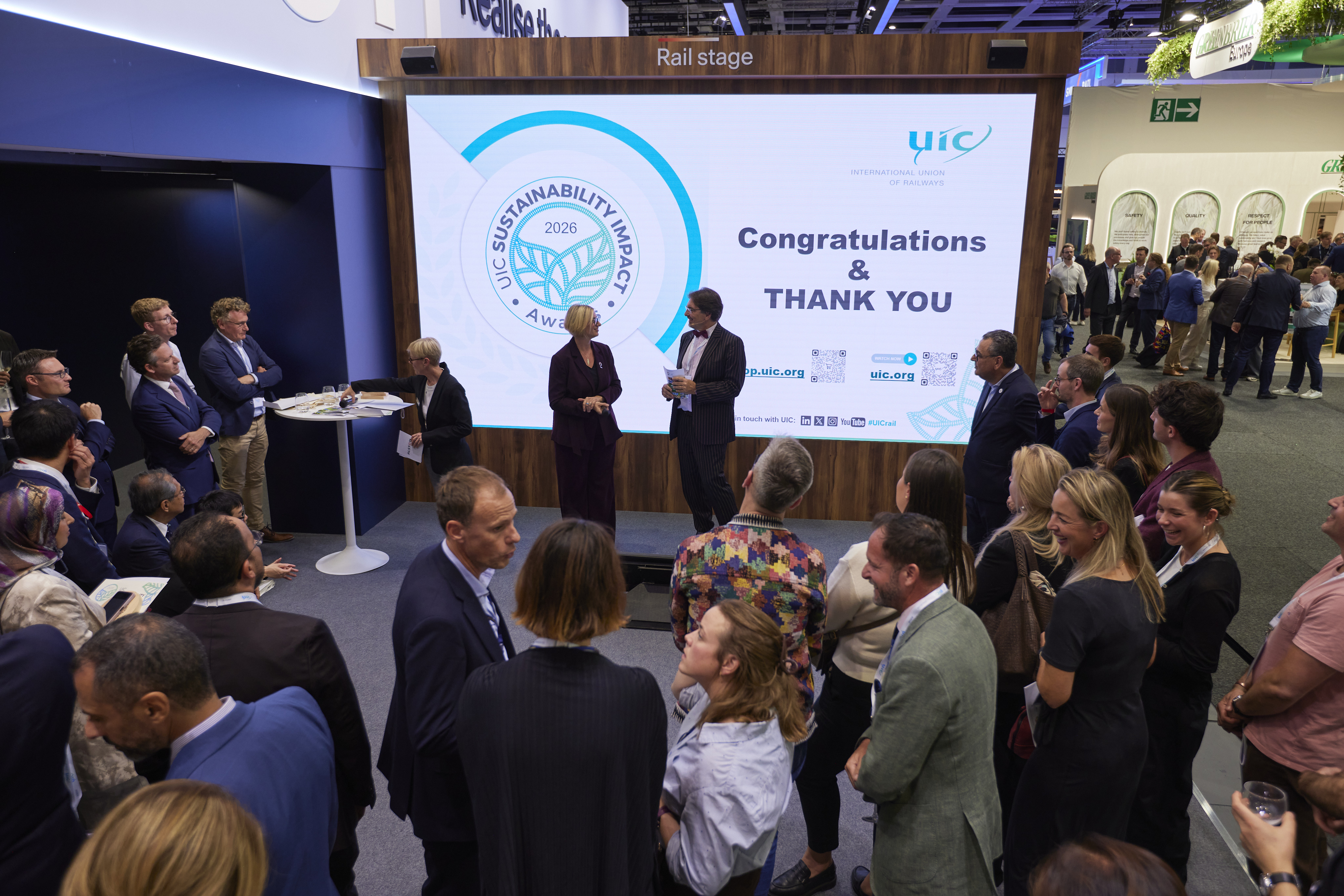
UIC Sustainability Impact Awards 2026 announcement screen, InnoTrans Berlin, Alstom's Rail Stage

The award announced live on the Rail Stage at Alstom's booth, InnoTrans Berlin — 23 September 2026

In Summary

The greenest building is the one already built.

Connolly 1844 proves it — with numbers, not aspiration.

88%
Operational energy reduction
2.5kg
CO₂e/m² embodied carbon
400×
Better than a new build
12yr
Capital cost recovery

Part of a Wider Body of Work

Research, Institution, Policy, Practice

This project didn't happen in isolation. It sits within a body of work spanning theoretical research, institutional guidance and international policy development — Connolly 1844 is the proof that these principles work in practice.

Research

RIAI Research Award 2026

"Bridging the Domain Gap in Historic Building Data" — the methodology underpinning the retrofit's evidence base. Read the paper ↗

Institution

ICOMOS Ireland NSCES+CC

President, National Scientific Committee on Energy, Sustainability + Climate Change — translating practice into national guidance. Committee page ↗

Policy

ICOMOS ISCES

Co-author, international thematic analysis of the EPBD recast across 19 countries — contributing to the EU sub-committee. Report launch ↗ · Read the publication ↗

Global Network

UIC Working Group One

Chair, Station Managers Global Group — sharing this methodology across the international railway community. UIC Stations page ↗